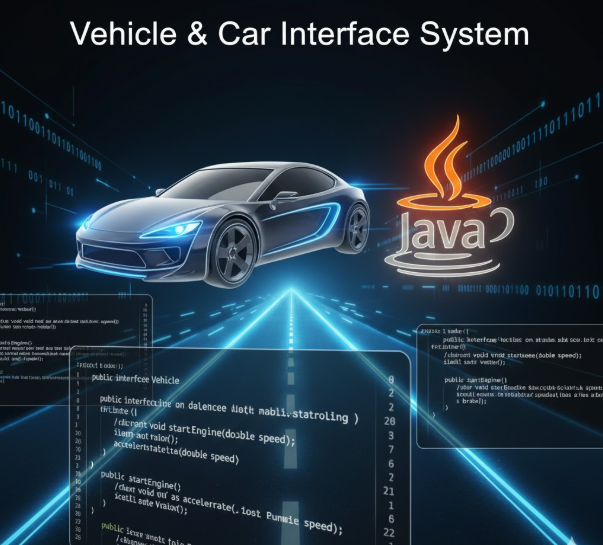
A comprehensive resource for the Vehicle Interface and Car Class implementation project. This download contains a technical report explaining key OOP concepts like encapsulation and polymorphism , along with a visual walkthrough for configuring the project in IntelliJ IDEA.
Problem Statement: Vehicle and Car
Interface: Vehicle Using IntelliJ, write a Java interface (not a class) called Vehicle that includes:
startEngine(): A method that returns void and simulates starting the vehicle's engine.
stopEngine(): A method that returns void and simulates stopping the vehicle's engine.
drive(int distance): A method that returns void and accepts an integer parameter representing the distance to be driven.
refuel(int amount): A method that returns void and accepts an integer parameter representing the amount of fuel to be added.
Class: Car Create a Java class called Car that implements the Vehicle interface that has:
Attributes:
fuelLevel (int): Represents the current fuel level of the car.
isEngineOn (boolean): Represents whether the car's engine is on or off.
Add at least one attribute to simulate additional functionality.
Implement all methods from the Vehicle interface:
In the startEngine() method, set isEngineOn to true and print a message indicating the engine has started.
In the stopEngine() method, set isEngineOn to false and print a message indicating the engine has stopped.
In the drive(int distance) method, reduce the fuelLevel by the distance driven (1 unit of fuel per unit distance) and print the distance driven.
In the refuel(int amount) method, increase the fuelLevel by the specified amount and print the new fuel level.
Add at least one method to simulate additional functionality.
Main Method In the main method, instantiate the Car class, and demonstrate the functionality of all the methods in the Car class by performing the following operations:
Start the car's engine.
Drive the car for a specified distance.
Stop the car's engine.
Refuel the car with a specified amount.
Project Structure Your project should contain 3 files:
Interface Vehicle.
Class Car.
Class containing the main method.
Sample Run Output
Plaintext
Starting the car's engine...
Engine started.
Driving for 50 units of distance...
Driven 50 units. Remaining fuel: 50
Stopping the car's engine...
Engine stopped.
Refueling the car with 30 units of fuel...
Refueled. Current fuel level: 80
Final car status:
Is engine on? false
Current fuel level: 80
(Note: The sample run text is reconstructed based on the visual output described in the file ).
Coding Guidelines
Add Javadoc for each class and each method within every class.
Use descriptive identifiers.
Use letter-case standards for naming variables, classes, and methods.
Use white space effectively (indenting blocks of code and blank lines between major sections).
Add inline or block comments for non-trivial parts of your code.