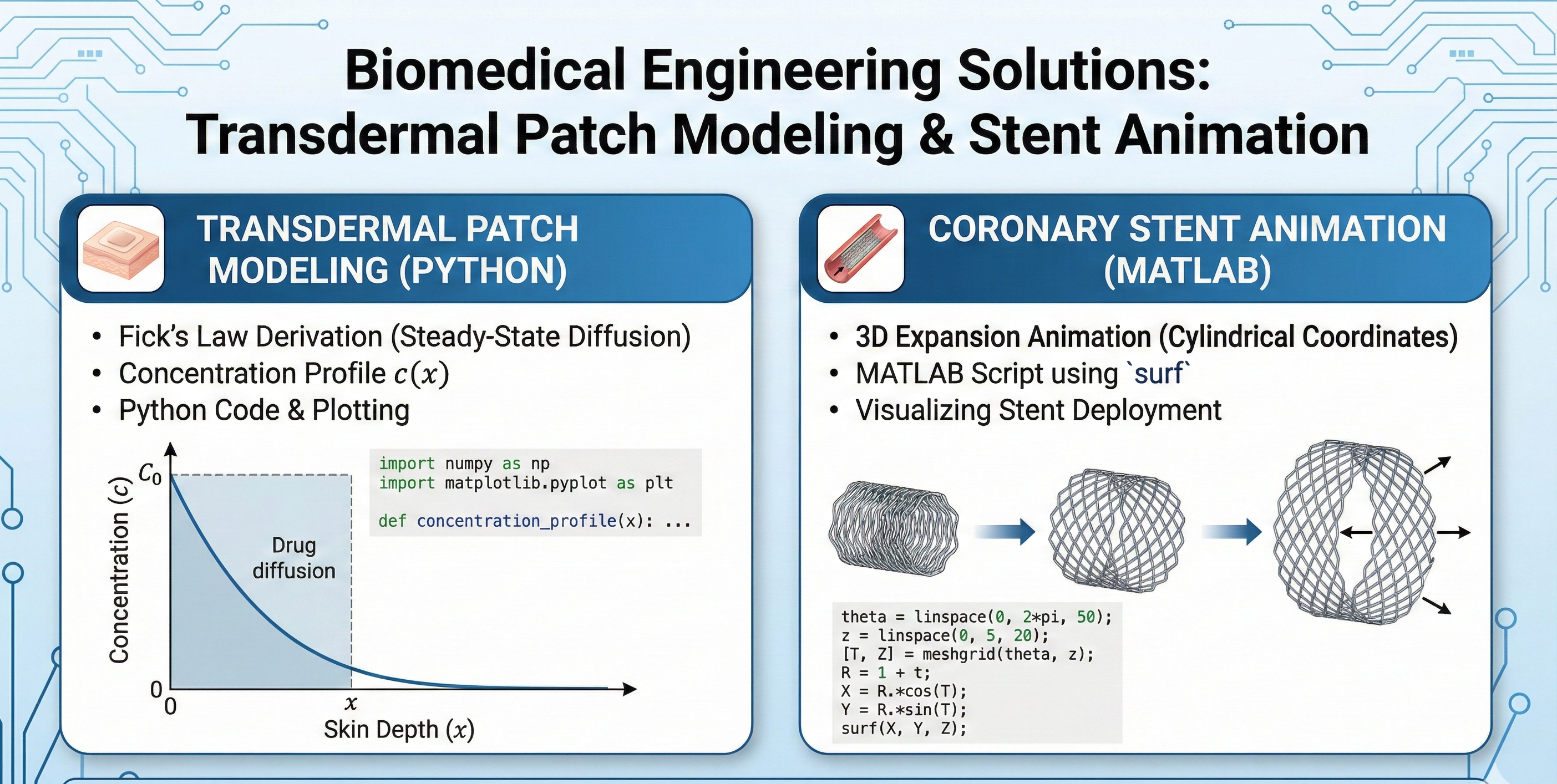
A complete solution guide for biomedical modeling tasks. This download includes the mathematical derivation and Python simulation for steady-state drug delivery via transdermal patches (Fick's Law), along with a MATLAB script for animating the expansion of a coronary stent.
Question 1 (50 pts). A transdermal patch is placed on the arm of a patient to deliver a specific dose of medication through the skin. The equation governing the concentration c of the drug is
∂c/∂t=D (∂^2 c)/(∂x^2 )- k_up c
where x is the depth through the skin, D is the diffusion coefficient and kup is the rate of uptake of the drug into the bloodstream.
Find the steady-state concentration as a function of x given the boundary conditions c = C0 at x = 0 (skin surface) and c = 0 at x = dc (critical depth). D, kup, C0 and dc are fixed parameters.
Fentanyl patches are typically designed to deliver a steady dose over an extended period, and the drug concentration can vary based on skin depth. Taking the diffusion coefficient D as 1×10⁻⁹ cm2/s, and starting concentration at the surface as 5 mg/cm3, model the drug concentration over skin depth in Python. Take 0.2 cm as critical depth, and select appropriate skin depth intervals. Produce a concentration profile and mark skin depth on the plot where drug concentration is half the initial concentration.
For drug A with a critical depth of 0.3 cm, (where the drug reaches a concentration of zero), and a diffusion coefficient of 0.8 x 10⁻⁹ cm2/s, determine C0 using the solution to part a. Assume the transdermal patch is designed to deliver 5 mg of the drug over 24 hours through an area of 10 cm². Suggest dimensions for the transdermal patch if the patch is made of a gel with an absorbency of 2 mg/cm3
Question 2 (50 pts). Create an animation in MATLAB of a coronary stent expanding from an initial radius of 1 cm to 3 cm. Model the stent as a cylinder with initial length of 10 cm. Submit both the code and a screen recording of your animation with your homework.