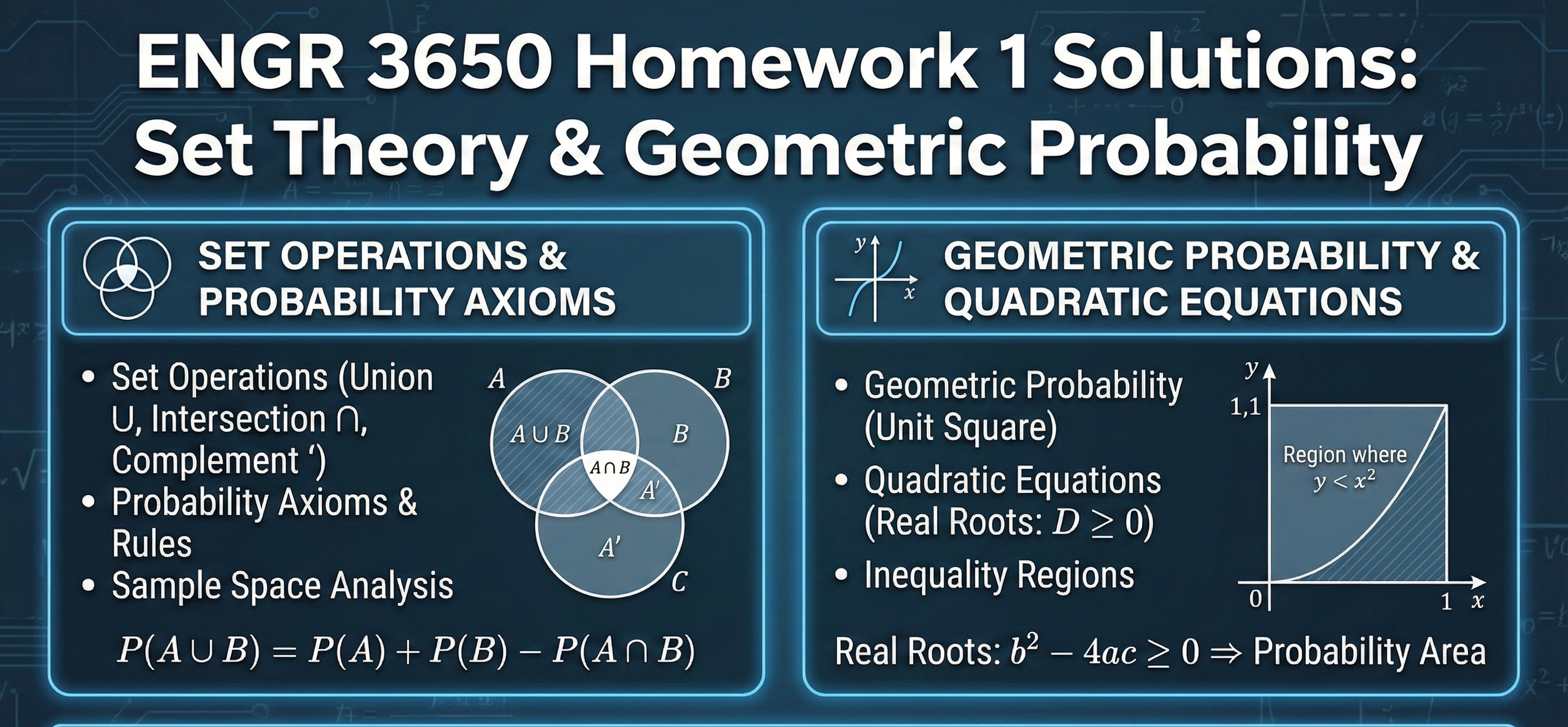
Complete solutions for ENGR 3650 Homework 1. This document covers Set Operations (Union, Intersection, Complement), Probability Axioms, and advanced problems such as calculating the probability of real roots in quadratic equations and solving Geometric Probability inequalities on a unit square.
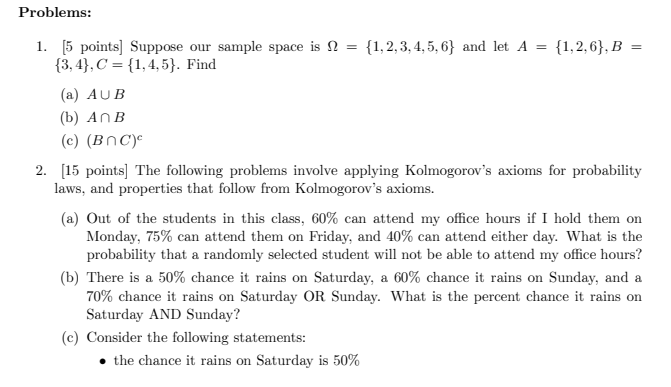
Problems:
1. [5 points] Suppose our sample space is Ω = {1, 2, 3, 4, 5, 6} and let A = {1, 2, 6}, B =
{3, 4}, C = {1, 4, 5}. Find
(a) A ∪ B
(b) A ∩ B
(c) (B ∩ C)c
2. [15 points] The following problems involve applying Kolmogorov’s axioms for probability
laws, and properties that follow from Kolmogorov’s axioms.
(a) Out of the students in this class, 60% can attend my office hours if I hold them on
Monday, 75% can attend them on Friday, and 40% can attend either day. What is the
probability that a randomly selected student will not be able to attend my office hours?
(b) There is a 50% chance it rains on Saturday, a 60% chance it rains on Sunday, and a
70% chance it rains on Saturday OR Sunday. What is the percent chance it rains on
Saturday AND Sunday?
(c) Consider the following statements:
• the chance it rains on Saturday is 50%
1
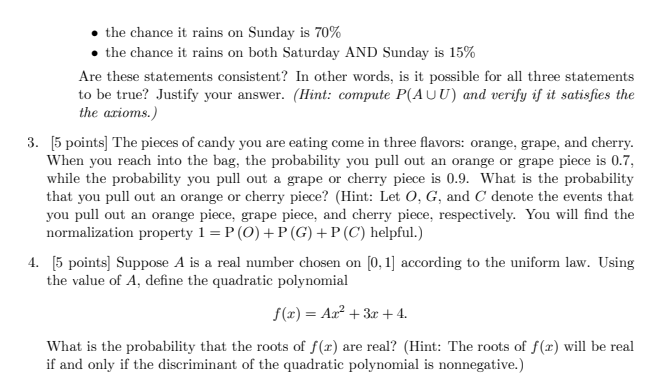
• the chance it rains on Sunday is 70%
• the chance it rains on both Saturday AND Sunday is 15%
Are these statements consistent? In other words, is it possible for all three statements
to be true? Justify your answer. (Hint: compute P(A ∪ U) and verify if it satisfies the
the axioms.)
3. [5 points] The pieces of candy you are eating come in three flavors: orange, grape, and cherry.
When you reach into the bag, the probability you pull out an orange or grape piece is 0.7,
while the probability you pull out a grape or cherry piece is 0.9. What is the probability
that you pull out an orange or cherry piece? (Hint: Let O, G, and C denote the events that
you pull out an orange piece, grape piece, and cherry piece, respectively. You will find the
normalization property 1 = P(O) + P(G) + P(C) helpful.)
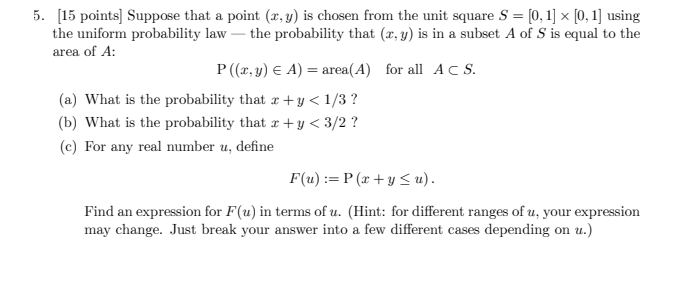
4. [5 points] Suppose A is a real number chosen on [0, 1] according to the uniform law. Using
the value of A, define the quadratic polynomial
f(x) = Ax2 + 3x + 4.
What is the probability that the roots of f(x) are real? (Hint: The roots of f(x) will be real
if and only if the discriminant of the quadratic polynomial is nonnegative.)
5. [15 points] Suppose that a point (x, y) is chosen from the unit square S = [0, 1] × [0, 1] using
the uniform probability law — the probability that (x, y) is in a subset A of S is equal to the
area of A:
P((x, y) ∈ A) = area(A) for all A ⊂ S.
(a) What is the probability that x + y < 1/3 ?
(b) What is the probability that x + y < 3/2 ?
(c) For any real number u, define
F(u) := P(x + y ≤ u).
Find an expression for F(u) in terms of u. (Hint: for different ranges of u, your expression
may change. Just break your answer into a few different cases depending on u.)