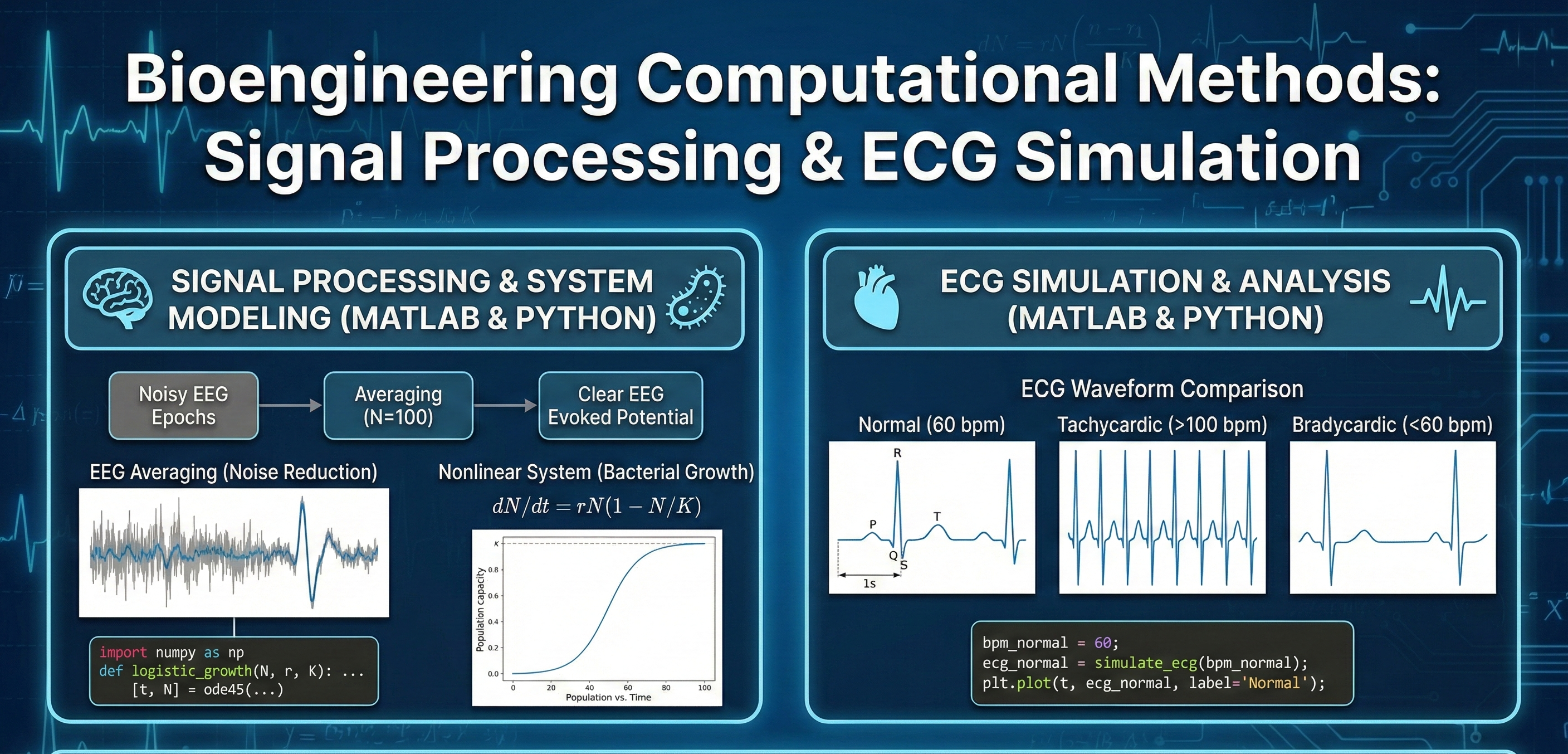
A comprehensive solution set for bioengineering modeling tasks. This download covers the theoretical analysis of EEG signal averaging and nonlinear system verification (bacterial growth), along with complete MATLAB and Python scripts for generating and comparing Normal, Tachycardic, and Bradycardic ECG waveforms.
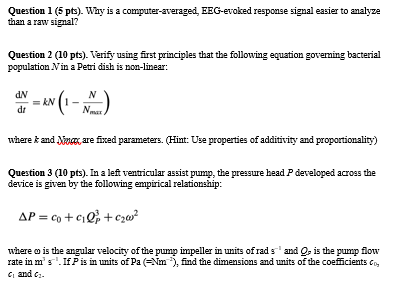
Question 1 (5 pts). Why is a computer-averaged, EEG-evoked response signal easier to analyze than a raw signal?
Question 2 (10 pts). Verify using first principles that the following equation governing bacterial population N in a Petri dish is non-linear:
where k and Nmax are fixed parameters. (Hint: Use properties of additivity and proportionality)
Question 3 (10 pts). In a left ventricular assist pump, the pressure head P developed across the device is given by the following empirical relationship:
where ω is the angular velocity of the pump impeller in units of rad s−1 and QP is the pump flow rate in m3 s−1. If P is in units of Pa (=Nm−2), find the dimensions and units of the coefficients c0, c1 and c2.
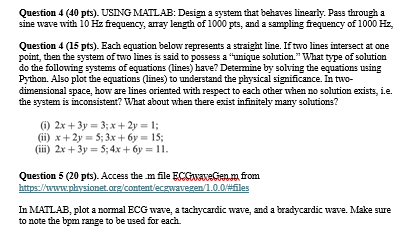
Question 4 (40 pts). USING MATLAB: Design a system that behaves linearly. Pass through a sine wave with 10 Hz frequency, array length of 1000 pts, and a sampling frequency of 1000 Hz, and plot the input sine wave and the output signal on the same plot. Explain how you can visually determine the system was linear?
Question 4 (15 pts). Each equation below represents a straight line. If two lines intersect at one point, then the system of two lines is said to possess a “unique solution.” What type of solution do the following systems of equations (lines) have? Determine by solving the equations using Python. Also plot the equations (lines) to understand the physical significance. In two-dimensional space, how are lines oriented with respect to each other when no solution exists, i.e. the system is inconsistent? What about when there exist infinitely many solutions?
Question 5 (20 pts). Access the .m file ECGwaveGen.m from https://www.physionet.org/content/ecgwavegen/1.0.0/#files
In MATLAB, plot a normal ECG wave, a tachycardic wave, and a bradycardic wave. Make sure to note the bpm range to be used for each.