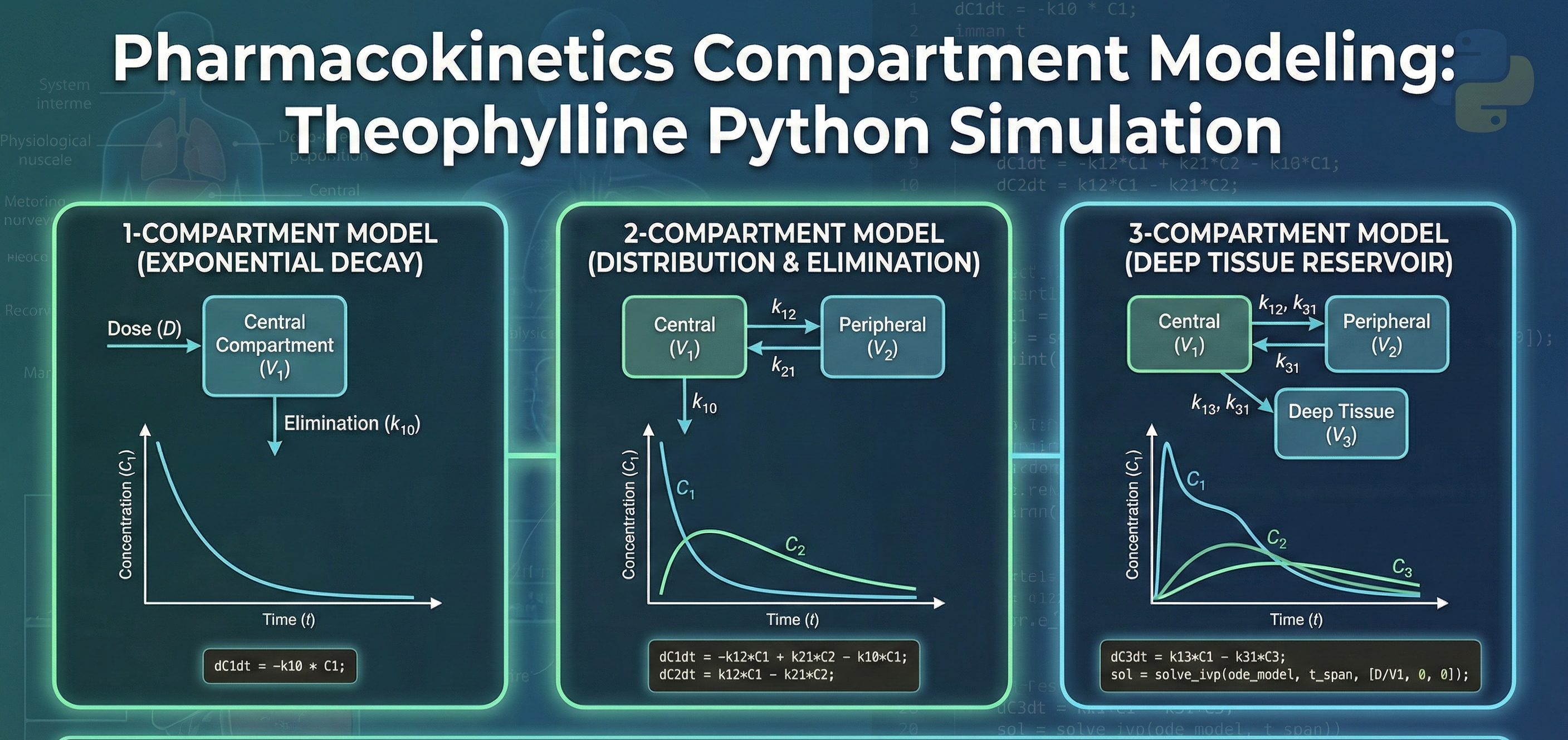
A comprehensive simulation project for analyzing drug distribution (Theophylline) using compartment modeling. This download includes Python scripts for solving 1-compartment, 2-compartment, and 3-compartment differential equations (ODEs) to visualize plasma concentration, elimination phases, and the deep-tissue reservoir effect.
Question 1 (20 pts). A 70 kg patient is administered a single 300 mg oral dose of Theophylline. Assume that absorption and elimination follow first-order kinetics, and the volume of distribution of the drug is the blood plasma only. The absorption rate constant is ka = 1.1 hr-1 , the elimination rate constant is ke = 0.17 hr−1, volume of distribution is Vd=35 L. Assume 100% absorption.
Using the following ODE to model the concentration of Theophylline in the plasma:
dC(t)/dt = (F ⋅ D_0 ⋅ k_a)/V_d ⋅ e^(-k_a t) - k_e ⋅ C(t)
Where D0 is the initial dose and F is the absorption fraction,
Solve the ODE numerically in Python to find the concentration-time profile for the drug over 24 hours.
Plot the plasma concentration C(t) vs. time and find the peak plasma concentration (C_max) and the time to reach it (T_max).
Question 2 (35 pts). You find that the model of Theophylline fails to be validated with experimental data and decide to adjust your assumption that the drug is distributed only through the blood plasma. Now consider that Theophylline distributes between a central compartment (plasma) and a peripheral compartment (tissues). After a 300 mg IV bolus dose, the drug distributes between the compartments with known transfer rates.
Elimination rate from central compartment ke = 0.17 hr−1
Transfer rate from central to peripheral k12 = 0.1 hr−1
Transfer rate from peripheral to central k21 = 0.05 hr−1
Volume of distribution in central compartment Vd1 = 35 L
Using the following system of ODEs to model the concentrations in the central and peripheral volumes,
(dC_1 (t))/dt=-k_12⋅C_1 (t)+k_21⋅C_2 (t)-k_e⋅C_1 (t)
(dC_2 (t))/dt=k_12⋅C_1 (t)-k_21⋅C_2 (t)
Solve the system numerically to simulate the drug concentrations in both compartments over 24 hours.
Analyze and compare the concentration-time profiles for the central and peripheral compartments. Discuss how the drug’s distribution between the two compartments affects the plasma concentration.
Question 3 (45 pts). Once again this model of Theophylline fails to be validated with experimental data. You decide now to further adjust your assumption that the drug is being distributed through only the blood plasma and peripheral tissues.
Using one of the conditions listed above that can be treated with Theophylline, justify the decision to model Theophylline transport into deep tissues in addition to central and peripheral volumes.
Consider Theophylline to now be distributed in three compartments: plasma (central compartment), tissue (peripheral compartment), and deep tissue (slow peripheral compartment), with different transfer rates. After an IV bolus dose of 300 mg, model the distribution dynamics across all three compartments.
Elimination rate from central compartment ke = 0.17 hr−1
Transfer rate from central to first peripheral compartment k12 = 0.1 hr−1
Transfer rate from first peripheral to central k21 = 0.05 hr−1
Transfer rate from first peripheral to deep tissue k13 = 0.02 hr−1
Transfer rate from deep tissue to first peripheral k31 = 0.01 hr−1
Volume of distribution in the central compartment Vd1 = 35 L
Using the following system of three ODEs for central, peripheral, and deep tissue comparments,
(dC_1 (t))/dt=-k_12⋅C_1 (t)+k_21⋅C_2 (t)+k_31⋅C_3 (t)-k_e⋅C_1 (t)
(dC_2 (t))/dt=k_12⋅C_1 (t)-k_21⋅C_2 (t)-k_13⋅C_2 (t)+k_31⋅C_3 (t)
(dC_3 (t))/dt=k_13⋅C_2 (t)-k_31⋅C_3 (t)
where C1(t), C2(t), and C3(t) are the concentrations in the central, first peripheral, and deep tissue compartments.
Solve the system numerically to simulate drug concentrations in each compartment over 48 hours.
Discuss the impact of the deep tissue compartment on the drug's overall pharmacokinetics. How does the slow transfer into and out of deep tissue affect the drug’s duration of action in the body?