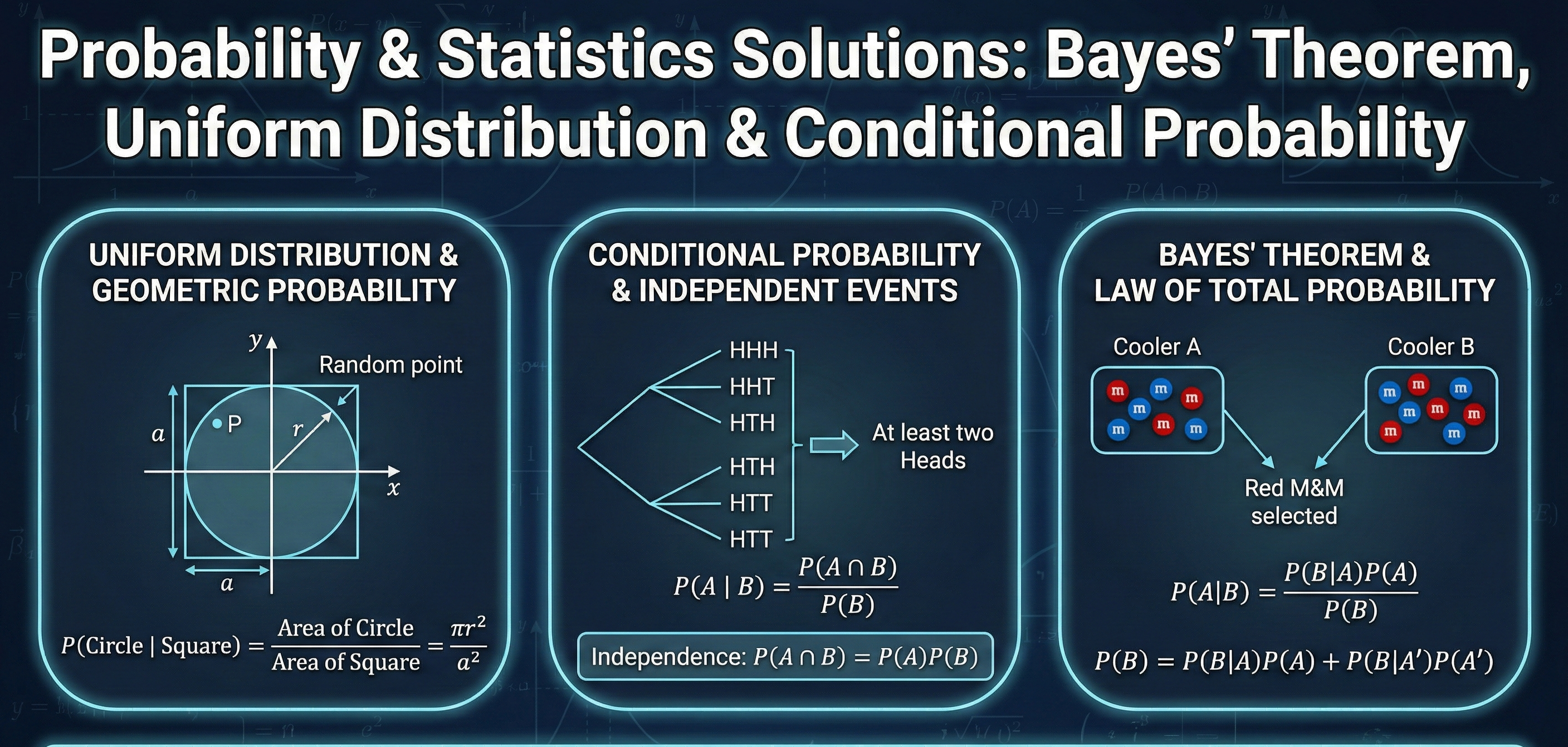
Probability & Statistics Solutions: Bayes' Theorem, Uniform Distribution & Conditional Probability ( Probability Theory, ENGR 3650, Winter 2025 )
A comprehensive solution set for advanced probability problems. This download covers uniform distribution on geometric regions (Square vs. Circle), conditional probability with independent events (Coin Flips), and complex Bayes' Theorem applications involving the "Cooler" and "M&Ms" scenarios.
Problems:
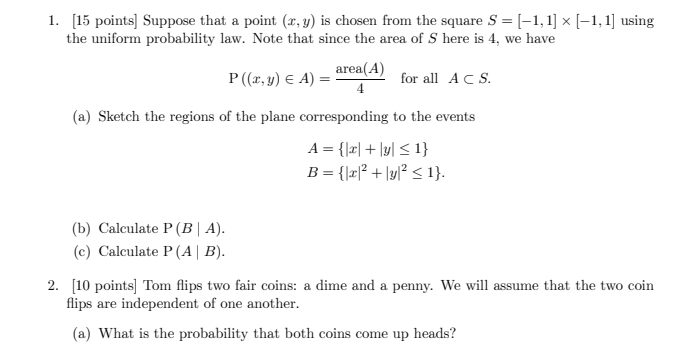
1. [15 points] Suppose that a point (x, y) is chosen from the square S = [−1, 1] × [−1, 1] using
the uniform probability law. Note that since the area of S here is 4, we have
P ((x, y) ∈ A) = area(A)
4 for all A ⊂ S.
(a) Sketch the regions of the plane corresponding to the events
A = {|x| + |y| ≤ 1}
B = {|x|
2 + |y|
2 ≤ 1}.
(b) Calculate P (B | A).
(c) Calculate P (A | B).
2. [10 points] Tom flips two fair coins: a dime and a penny. We will assume that the two coin
flips are independent of one another.
(a) What is the probability that both coins come up heads?
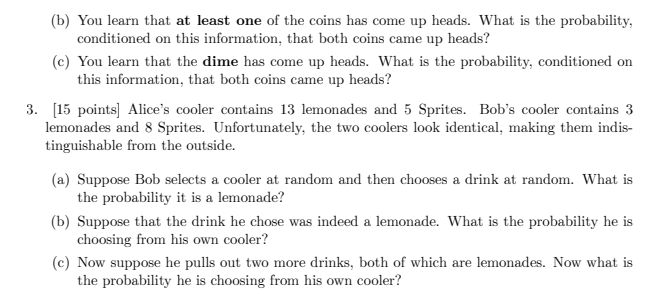
1
(b) You learn that at least one of the coins has come up heads. What is the probability,
conditioned on this information, that both coins came up heads?
(c) You learn that the dime has come up heads. What is the probability, conditioned on
this information, that both coins came up heads?
3. [15 points] Alice’s cooler contains 13 lemonades and 5 Sprites. Bob’s cooler contains 3
lemonades and 8 Sprites. Unfortunately, the two coolers look identical, making them indistinguishable from the outside.
(a) Suppose Bob selects a cooler at random and then chooses a drink at random. What is
the probability it is a lemonade?
(b) Suppose that the drink he chose was indeed a lemonade. What is the probability he is
choosing from his own cooler?
(c) Now suppose he pulls out two more drinks, both of which are lemonades. Now what is
the probability he is choosing from his own cooler?
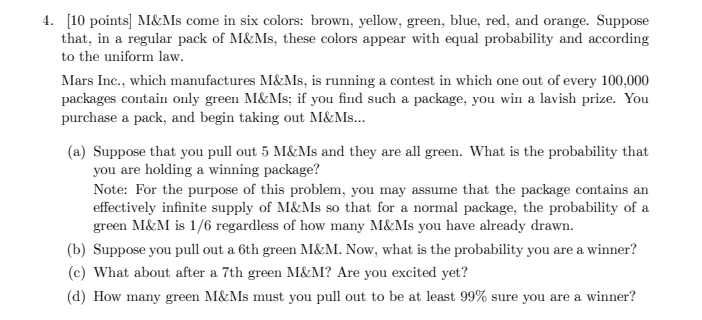
4. [10 points] M&Ms come in six colors: brown, yellow, green, blue, red, and orange. Suppose
that, in a regular pack of M&Ms, these colors appear with equal probability and according
to the uniform law.
Mars Inc., which manufactures M&Ms, is running a contest in which one out of every 100,000
packages contain only green M&Ms; if you find such a package, you win a lavish prize. You
purchase a pack, and begin taking out M&Ms...
(a) Suppose that you pull out 5 M&Ms and they are all green. What is the probability that
you are holding a winning package?
Note: For the purpose of this problem, you may assume that the package contains an
effectively infinite supply of M&Ms so that for a normal package, the probability of a
green M&M is 1/6 regardless of how many M&Ms you have already drawn.
(b) Suppose you pull out a 6th green M&M. Now, what is the probability you are a winner?
(c) What about after a 7th green M&M? Are you excited yet?
(d) How many green M&Ms must you pull out to be at least 99% sure you are a winner?